
Episode 9 of 10: Retail Format Financial Metrics

Business models and their impact on profitability, efficiency, and returns.
Each format has a distinct balance of scale, margin, and efficiency. Ultimately, format choice dictates the financial profile and the resilience of a retailer’s operating model.
Note: All retail format data is based on the head office location of the top 100 retailers.
Profitability Standouts
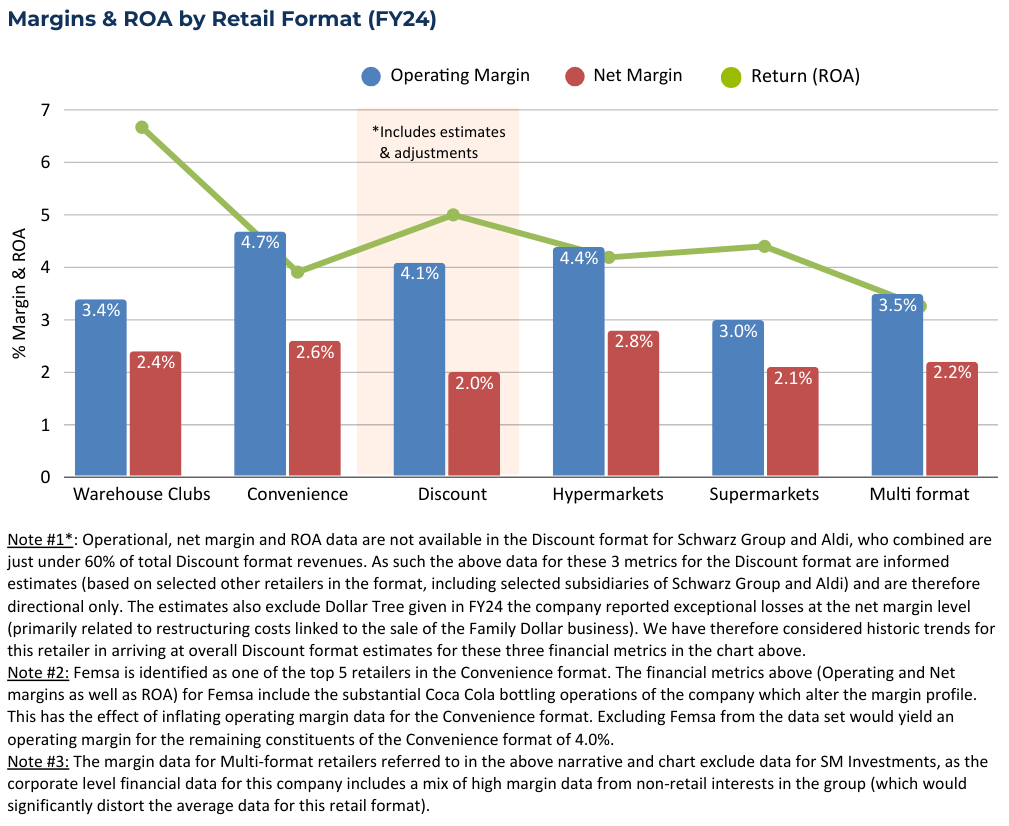
- Operating Margins: The Convenience format leads at 4.7%, followed by Hypermarkets (4.4%) and Discount (4.1%). Supermarkets have the lowest operational profitability at 3.0%, reflecting higher operating expenses and lower levels of profit translation.
- Net Margins: Hypermarkets are highest at 2.8%, indicating effective cost control below the operational level. Convenience (2.6%) and Warehouse Clubs (2.4%) also operate above the top 100 average.
The Efficiency and Return (ROA) Advantage
- Efficiency: Warehouse Clubs have the highest efficiency, reflecting an operating model centred on scale and productivity. Costco is the global benchmark here, with the highest efficiency level of any retailer in the top 100. Discounters also operate with efficiency levels materially ahead of traditional grocery formats.
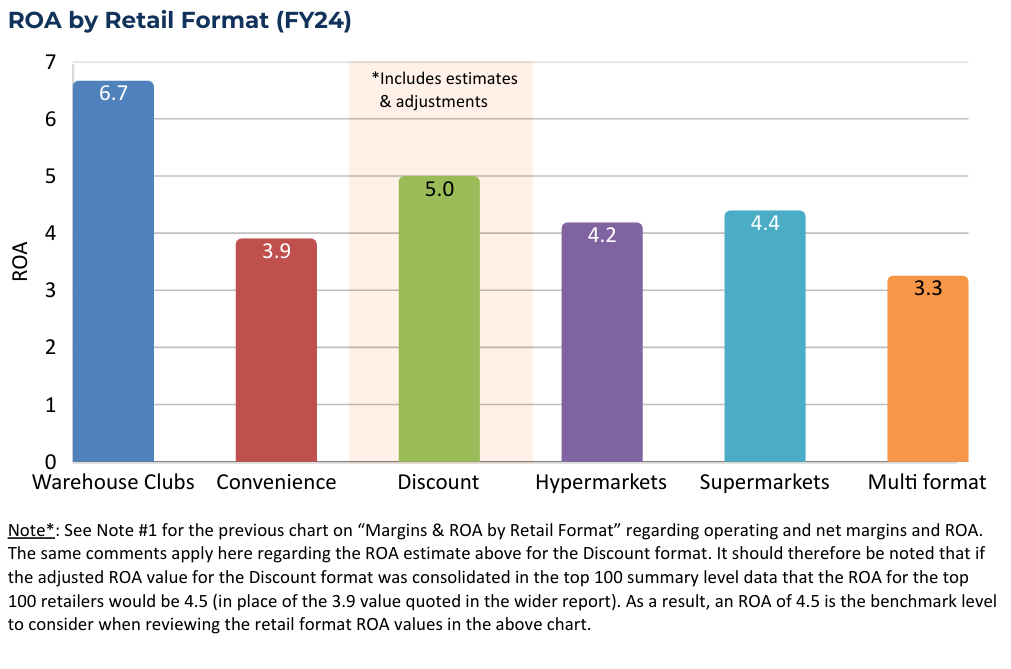
- Return on Assets (ROA): Warehouse Clubs stand highest at 6.7. The Discount format also enjoys above-average returns at 5.0, with both formats heavily supported by efficiency strengths in their operating models.
- Mainstream Challenges: Supermarkets have slightly above-average returns (4.4), but this masks wide geographic differences. US leaders like Kroger and Publix have well-above-average returns, while many European supermarkets sit below the mark. Multi-format retail has the lowest average returns at 3.3, though again, leader Walmart is an outlier with high returns of 7.6%.
Retail Format Headlines

- Warehouse Clubs and Discounters excel in asset utilization and operational efficiency. This high-efficiency model directly translates into superior levels of return (ROA) compared to other formats.
- Convenience stores achieve strong operating profitability through premium pricing and curated ranges. However, they remain one of the least efficient formats, resulting in only average overall returns.
- Mainstream grocery retail formats (Supermarkets, Hypermarkets, and Multi-format retailers) command 75% of total revenue but are facing competitive headwinds to varying degrees on margin (Supermarkets and Multi-format) and efficiency (Hypermarkets and Multi-format).
- The Scale Advantage. In all formats except Convenience, increased scale correlates with higher profitability, efficiency and returns (ROA). Retail format leaders (e.g. Costco, Walmart, Schwarz Group / Aldi, Target, Kroger) tend to be advantaged on each of these metrics.
- The US Geographic Factor. Retail economics in the US provide a unique tailwind, with domestic retailers typically outperforming global format peers on efficiency and profitability. See our earlier Regional analysis episodes in this series for more detail.
- Format-Driven Financial DNA. A retailer's financial profile is a direct reflection of its format choice and the associated balance of margin and efficiency. Currently, Warehouse Club and Discount models are most advantaged, while other formats struggle to reach the 4.5% adjusted ROA average (see “Note” in above chart).

Enjoying the series?
Subscribe to get access to each future episode delivered straight to your inbox, as they become available
Subscribe for the full series on our Resources page
This series is a curated version of our full report which covers wider analysis and reporting supported by more extensive graphics and tables than this headline episode format allows. It also includes a ranked table of the top 100 global grocery retailers. Look out on our Resources page for future releases and where you can also get in touch with us to learn more.
Notice
© Comsensus Limited. All rights reserved.
These materials may not be reproduced or distributed in part or in full, in any form or by any means, electronic or mechanical, including photography, recording, or any information storage and retrieval system now known or to be invented, without the express written permission of Comsensus Limited.
These materials may not be reproduced or distributed in part or in full, in any form or by any means, electronic or mechanical, including photography, recording, or any information storage and retrieval system now known or to be invented, without the express written permission of Comsensus Limited.
Disclaimer
The data, information and analysis contained in these materials represent the opinions of Comsensus Limited. The views expressed do not necessarily reflect the views of the management of the business(es) under discussion. These materials are not endorsed or otherwise supported by the management of any of the companies or organizations discussed herein. Nothing in these materials constitutes financial advice in any way whatsoever, nor should any data or content be relied upon for any investment activities.